
For years, 3D printing was primarily associated with one thing: prototyping. Engineers used additive manufacturing to quickly turn CAD files into physical parts, evaluate designs, check fit and function, and make changes before committing to conventional manufacturing.
That is still an important use of the technology, but additive manufacturing has moved well beyond the prototype stage.
Today, advanced additive manufacturing processes, production-grade materials, improved equipment, and stronger quality controls are making AM a practical production method for a growing range of end-use applications. Manufacturers can use additive manufacturing for bridge production, replacement parts, tooling, low- and mid-volume components, customized products, and, in the right applications, production quantities reaching into the thousands.
The important question has changed.
 Instead of simply asking, “Can this part be 3D printed?” manufacturers need to ask, “Can this part be produced repeatedly, economically, and at the quality level our application requires?”
Answering that question requires more than access to a 3D printer. It requires an additive manufacturing partner built for production.
Prototype Provider vs. Production AM Partner
Producing one successful prototype and producing hundreds or thousands of consistent components are very different manufacturing challenges.
Production changes the requirements.
When an additive part becomes an end-use component, manufacturers need confidence that part number 500 will perform like part number five. Material properties, dimensional accuracy, equipment condition, build orientation, process parameters, post-processing, inspection, and quality controls become increasingly important.
That is one of the key distinctions between a prototype-focused provider and an industrial additive manufacturing partner.
A production partner should be able to evaluate the complete application, not simply process the CAD file. That means considering how the part will be used, its mechanical and environmental requirements, tolerances, material characteristics, expected quantities, inspection requirements, and future demand.
The objective is not simply to print the part. It is to establish a repeatable manufacturing process.
Quality and Repeatability Become Critical
Repeatability is one of the biggest considerations when moving additive manufacturing into production.
Industrial AM relies on controlled processes to consistently reproduce the required geometry and performance. Equipment, material handling, build parameters, machine maintenance, post-processing, and inspection all contribute to the final result.
A structured quality management system becomes especially valuable as production quantities increase.
 3D Parts Unlimited is ISO 9001:2015 certified, providing a documented quality framework designed around consistency, traceability, risk mitigation, and repeatable processes. Our quality system encompasses areas including order processing, additive manufacturing, quality control, packaging, and shipping.
For manufacturers evaluating AM for production, that structure matters. The conversation is no longer about whether a supplier can successfully print a sample. It is about whether that supplier has the processes necessary to reliably reproduce the component as demand continues.
The Right Material and Process for the Application
Scaling additive manufacturing also requires moving beyond the idea of “3D printing” as a single process.
Different AM technologies offer different combinations of mechanical properties, surface finish, resolution, production speed, material availability, and economics.
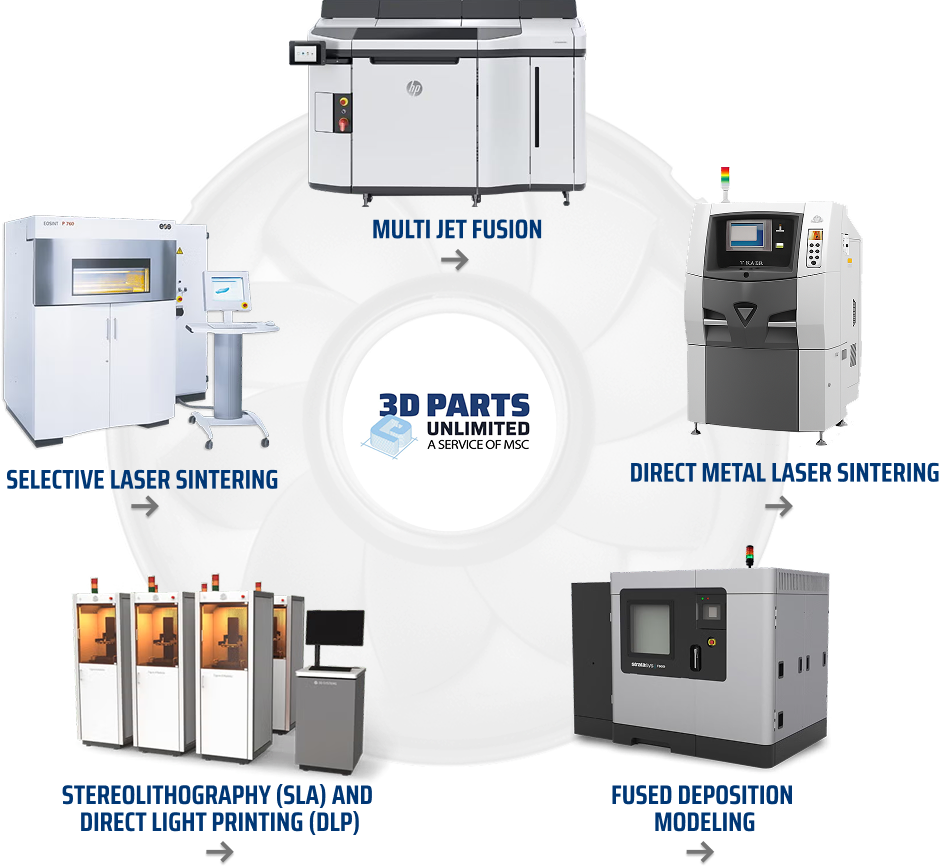
3D Parts Unlimited offers multiple industrial additive technologies, including Multi Jet Fusion (MJF), Selective Laser Sintering (SLS), Fused Deposition Modeling (FDM), SLA/DLP, and Direct Metal Laser Sintering (DMLS). This range allows the manufacturing process to be matched to the actual requirements of the application rather than forcing every component into one technology.
Material selection is equally important.
Production applications may require strength, temperature resistance, chemical resistance, flexibility, dimensional stability, or other specific mechanical properties. The appropriate combination of material and printing process needs to be evaluated against those requirements.
For example, 3D Parts Unlimited’s HP Multi Jet Fusion capabilities use production-grade powdered materials that can produce solid, durable components with chemical resistance and high-temperature deflection. Applications include end-use production components, housings, fixtures, tooling, simplified assemblies, and low- through high-volume applications.
This application-driven approach is essential when moving from a prototype that demonstrates a concept to a production part expected to perform a function.
Where Does Production AM Make Sense?
Additive manufacturing is not intended to replace every conventional manufacturing process.
At very high volumes, processes such as injection molding may still provide a lower per-part cost once tooling has been created and production is stabilized. The value of AM becomes particularly compelling when conventional manufacturing introduces tooling costs, long lead times, minimum order quantities, excess inventory, or design limitations.
That creates several strong production applications for AM.
Low- and mid-volume production runs can eliminate the need to invest in tooling before demand justifies it. Bridge production can keep products moving while molds or other conventional production equipment are being developed. Replacement and obsolete parts can be produced on demand rather than stored indefinitely. Tooling, fixtures, robotic grippers, housings, and other industrial components can be manufactured quickly without consuming internal machining capacity. Complex or consolidated components can also take advantage of geometries that may be difficult or expensive to manufacture conventionally.
 The ideal production volume therefore cannot always be defined by a single number.
Part geometry, size, material, process, tooling costs, conventional manufacturing lead time, inventory requirements, and annual demand all affect the crossover point.
In some applications, that crossover point can be surprisingly high.
One 3D Parts Unlimited production case demonstrates this clearly. When a customer needed 5,000 front sights and 5,000 rear sights but could not obtain injection molds and molded parts within the required timeframe, 3D Parts Unlimited used Multi Jet Fusion to manufacture the components. A total of 10,000 end-use parts were produced in three days, at a cost comparable to injection molding but without the upfront tooling requirement.
That example highlights an important point: production AM should be evaluated based on the complete manufacturing equation, not simply unit price.
Look Beyond Cost Per Part
Comparing additive manufacturing with conventional production solely on piece price can hide some of AM’s most significant advantages.
Consider the cost and time associated with tooling. Consider minimum order quantities, inventory carrying costs, warehousing, engineering changes, obsolete inventory, replacement-part availability, and the production delays that can occur while waiting for conventional tooling.
Additive manufacturing changes that equation because production begins with a digital file rather than dedicated tooling.
Manufacturers can produce what they need, when they need it. Designs can be updated without replacing a mold. Production can scale as demand becomes clearer. Parts that would otherwise require stocked inventory can potentially become part of a digital inventory strategy.
The result can be a more flexible supply chain with less capital tied up in tooling and physical inventory.
Moving from Prototype to Production with Confidence
Scaling additive manufacturing requires a different mindset than ordering a prototype.
The focus shifts from speed alone to process capability, quality, repeatability, material performance, documentation, capacity, and long-term production economics.
That is why selecting the right AM partner matters.
3D Parts Unlimited supports manufacturers from one-off prototypes through production-ready components, combining technologies such as MJF, SLS, FDM, SLA/DLP, and DMLS with engineered materials, controlled processes, and production capacity.
The opportunity is not to replace conventional manufacturing everywhere. It is to identify the applications where additive manufacturing creates a better production strategy.
For manufacturers facing high tooling costs, unpredictable demand, long lead times, difficult geometries, replacement-part challenges, or low- and mid-volume requirements, the next production solution may not require a mold, fixture, or lengthy setup. It may start with a digital file.